Why I’m Taking My Bone Health Seriously After 50!
Bones aren’t particularly exciting.
Until suddenly they are.
For me, thinking about bone health didn’t begin with a DEXA scan or a diagnosis. It actually started more than 40 years ago.
It started with my grandmother
I began strength training in my 20s, and one of the reasons was very simple.
I looked at my grandmother as she grew older. She was hunched over, fragile and frail, and I distinctly remember thinking:
“I don’t want that to be me when I’m older.”
At that age, I certainly wasn’t thinking about osteopenia, osteoporosis, bone mineral density or menopause.
I just knew I wanted to be strong.
I wanted to stand tall.
And I wanted to remain capable and independent as I got older.
That thought has stayed with me throughout my life.
Then osteoporosis became even more personal
Years later, my mother was diagnosed with osteoporosis in her 70s.
She was prescribed a type of osteoporosis medication called a bisphosphonate.
Bisphosphonates work by slowing down the cells responsible for breaking down old bone. This can help slow bone loss and reduce the risk of fractures.
Unfortunately, while taking hers, my mother developed a serious problem with her eye and ultimately lost the sight in her left eye.
Eye inflammation has been reported as an uncommon adverse effect associated with bisphosphonates. However, I can’t say with certainty that the medication caused what happened to my mother.
What I can say is that the experience made me even more aware of the importance of looking after my own bones.
I knew I had my own risk factors
I’m quite small-boned, and osteoporosis has affected women in my family.
A thin or small body build is associated with increased osteoporosis risk, and family history — particularly osteoporosis in a parent or sibling — is another recognised risk factor.
Those aren’t things I can change.
But that doesn’t mean there’s nothing I can do.
And that’s become a really important philosophy for me as I get older:
Don’t obsess about the things you can’t control. Take action on the things you can.
For me, the first step was finding out what was actually happening with my own bones.
So I had a DEXA scan
A DEXA (or DXA) scan measures bone mineral density and is commonly used to identify low bone density and osteoporosis.
I decided to have one rather than waiting until I was much older.
And the result surprised me.
I have mild osteopenia in my femoral neck.
The femoral neck is the area of bone just below the ball of the hip joint.
Was I thrilled to discover that?
Absolutely not.
But am I glad I know?
Yes.
Because osteopenia isn’t osteoporosis, and for me this result isn’t a reason to panic.
It’s information I can act on.
And that’s exactly what I’m doing.
The $160 I consider an investment in my future
I paid approximately $160 for my DEXA scan here in Australia.
And I’ve decided that monitoring my bone health is something I’m prepared to make room for in my budget when clinically appropriate.
Medicare rebates for bone-density testing are available in certain circumstances, including specific risk factors and for people aged 70 and over, subject to eligibility requirements.
But personally, I didn’t want to wait until my 70s before finding out what was happening with my bones.
I want the information while I still have time to act on it.
For me, that $160 wasn’t simply the cost of a medical test.
It was an investment in knowledge.
I’d rather spend money finding out about my bones now than discover there was a problem after suffering a fracture.
My training has changed
I’ve strength trained for decades.
But my DEXA result made me reconsider whether what I was doing was specifically addressing bone health, rather than simply maintaining muscle and fitness.
That’s an important distinction.
Strong muscles don’t automatically mean strong bones.
You can look fit.
You can feel strong.
You can exercise regularly.
And you can still have reduced bone density.
So I’ve rearranged my own training and become much more deliberate about incorporating the types of activity that place an appropriate stimulus on bone.
That includes progressive resistance training and appropriate weight-bearing and impact exercise, alongside the strength work I was already doing.
The right exercise will be different for everyone, particularly if osteoporosis, previous fractures or other medical conditions are present, so this is an area where individual professional advice matters.
Why bone health becomes so important in midlife
Bone is living tissue. Throughout our lives, old bone is continually being broken down and new bone is being formed.
As we get older, that balance changes.
For women, menopause is particularly important because lower oestrogen levels are associated with accelerated bone loss.
This is one reason I believe bone health deserves a place in conversations about women’s health in midlife.
We talk a lot about hot flushes, weight, sleep and other menopause symptoms.
But what’s happening to our bones isn’t something we can see in the mirror.
And we may not know there’s a problem until bone density is measured — or a fracture occurs.
It’s not just about bone density. It’s about falls.
This is another area I’ve become increasingly conscious of.
As we age, a combination we really don’t want is:
Reduced bone strength + reduced muscle strength + poor balance + a fall.
A fracture can significantly affect mobility and independence, particularly later in life.
So protecting my future isn’t simply about trying to increase a number on a DEXA report.
It’s about the bigger picture:
Build and maintain bone.
Build and maintain muscle.
Train balance.
Maintain mobility.
Stay physically capable.
Reduce the risk of falls.
Because ultimately, I’m not interested in having good bone density simply so I can say I have good bone density.
I want strong bones because I want to remain independent.
I’ve changed what I eat too
My DEXA result also made me look more closely at my nutrition.
In particular, I’ve become much more conscious of calcium.
I’m currently choosing to get my calcium primarily through food rather than taking calcium tablets.
That means deliberately including more calcium-rich foods in my diet.
I’ve increased things such as:
Sardines — including the edible bones
Calcium-rich milk
Dairy and other calcium-rich foods
And yes, sardines have suddenly become much more interesting to me than they used to be! 😂
For Australian women over 50, Healthy Bones Australia recommends 1,300 mg of calcium per day, preferably from food.
Protein is also important for maintaining muscle, while vitamin D helps the body absorb calcium.
Again, everyone’s nutritional and medical circumstances are different, so supplements aren’t something I believe we should automatically prescribe for ourselves simply because we’ve reached a certain age.
And let’s not forget balance
We can spend a lot of time talking about bone density while overlooking something incredibly practical:
Can you stop yourself from falling?
Balance is something we can train.
Strengthening our legs and core, maintaining mobility and practising appropriate balance exercises can help us remain more stable and capable.
We cannot prevent every fall.
But improving the physical abilities that help us react when we stumble makes sense to me as part of a broader healthy-ageing strategy.
Is it too late to do something about your bones?
This is perhaps the most important part of this article.
Getting older doesn’t mean giving up on your bones.
Resistance training, appropriate weight-bearing and impact exercise, balance work, adequate calcium, vitamin D and good nutrition are all recognised components of supporting bone health.
What is appropriate will depend on your existing bone density, medical history, fracture risk and physical capability.
If you have osteoporosis or significant bone loss, exercise should be individually tailored with an appropriately qualified health professional.
For me, discovering mild osteopenia wasn’t the end of the story.
It was information that allowed me to write the next part differently.
More than 40 years later, my reason hasn’t really changed
I started strength training in my 20s because I looked at my grandmother and didn’t want to become a frail older woman.
Today, that motivation is stronger than ever.
But now I understand that staying strong isn’t simply about muscles.
It’s about bones, balance, mobility, nutrition and the choices we make long before we think we’re “old.”
I’m not frightened of ageing.
I want to prepare for it.
I want to give the woman I’ll be at 70, 80 and beyond the best possible chance of remaining active, capable and independent.
And that’s why I’m prepared to invest some money, some time and some effort into my bones today.
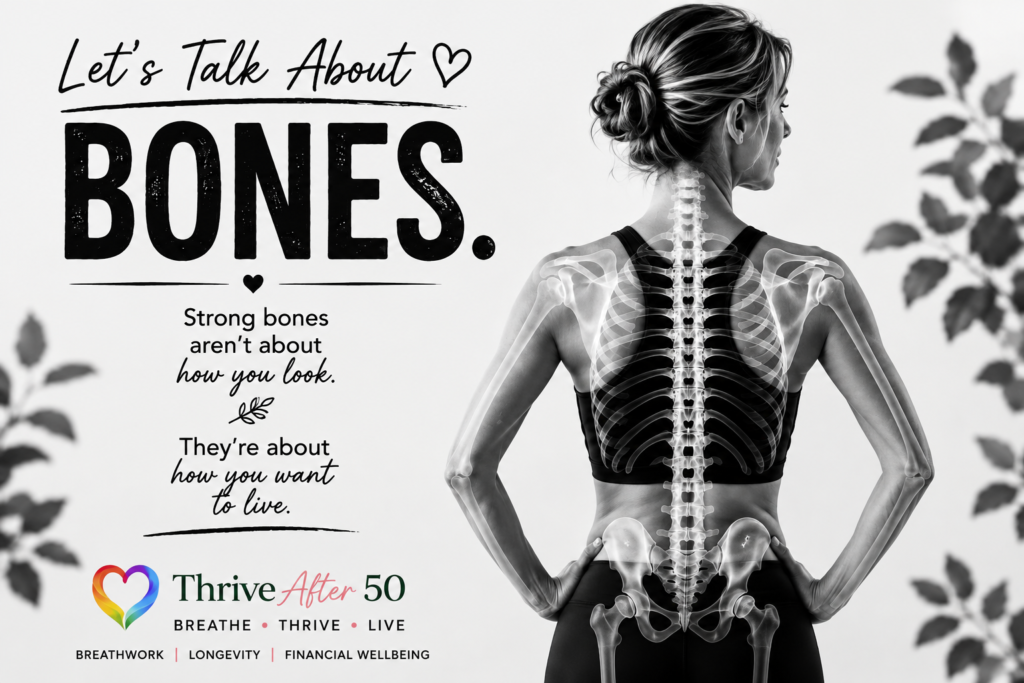
❤️ Strong bones aren’t about how you look.
They’re about how you want to live.
What about your bones?
If you’re in midlife and have never thought about your bone health, consider discussing your individual risk factors with your GP.
Family history, body build, menopause, previous fractures, certain medical conditions and medications can all influence whether bone-density testing may be appropriate.
You don’t need to become frightened about ageing.
But I do believe there’s enormous value in knowing where you stand and taking action where you can.
That’s very much what Thrive After 50 means to me:
Not simply adding years to our lives — but doing what we can to remain strong, capable and independent enough to enjoy them.
This article shares my personal experience and is for general educational purposes only. It isn’t medical advice. Speak with your GP or an appropriately qualified health professional about your individual bone health, DEXA testing, medication, supplementation and appropriate exercise.